
Most crypto press releases never see the light of day. You spend hours crafting what you think is newsworthy content, submit it to top outlets like CoinDesk and Cointelegraph, and… silence. The rejection stings, especially when you see competitors getting featured for announcements that seem less significant than yours.
Here’s the reality: crypto journalists receive hundreds of press releases weekly. Most get deleted within 30 seconds. The difference between getting published and getting ignored isn’t about having bigger news—it’s about understanding what makes cryptocurrency press releases work in 2025.
After reviewing thousands of submissions and seeing which announcements actually break through, the pattern becomes clear. Successful crypto press releases follow specific structures, avoid common pitfalls, and speak the language journalists expect. They’re not overhyped promotional pieces. They’re newsworthy stories told with clarity and backed by substance.
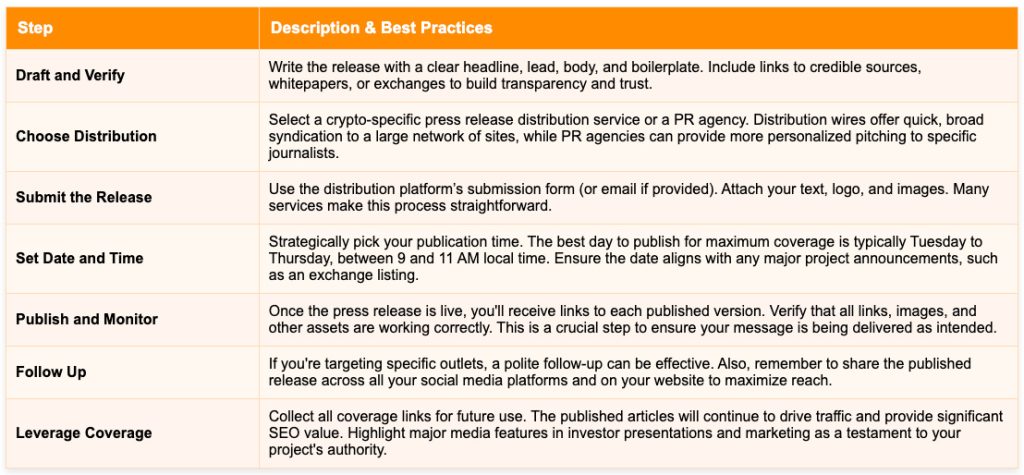
This guide walks you through the complete process of writing press releases that crypto media actually wants to publish. You’ll learn the exact structure top outlets prefer, how to identify whether your announcement is truly newsworthy, and the distribution strategies that get results. We’ll cover everything from crafting headlines that grab attention to measuring the impact of your coverage.
Whether you’re announcing a token launch, partnership, funding round, or exchange listing, you’ll have a proven framework for creating press releases that earn media coverage instead of landing in the trash folder. No fluff, no generic advice—just the practical techniques that work for blockchain projects in 2025.
What You Need to Know About Crypto Press Releases
Why invest time and budget into press releases when you could just post on X or Telegram? Because earned media coverage does something social posts can’t — it validates your project through third-party credibility.
When CoinDesk or Cointelegraph publishes your announcement, you’re not just reaching their audience. You’re borrowing their authority. Institutional investors who ignore Twitter threads will read coverage on established crypto outlets. Potential partners take you more seriously. Your community gains confidence knowing recognized publications find your project newsworthy.
Since major platforms restrict crypto advertising, projects must leverage alternative channels. While crypto display ads and native advertising provide ongoing visibility on crypto-focused websites, press releases offer one-time spikes in credibility and coverage that complement sustained advertising campaigns.
Press releases also deliver compounding returns that social media doesn’t. A single article on BeInCrypto stays indexed forever, sending referral traffic months or years later. The backlinks improve your domain authority. Search rankings increase for your brand terms and key phrases.
The crypto projects that consistently secure media coverage aren’t necessarily the ones with the biggest announcements — they’re the ones that understand what makes news publishable. Here’s what press releases actually accomplish for blockchain projects.
What Is a Crypto Press Release?
A crypto press release is an official news announcement distributed by blockchain projects to media outlets, investors, and the public. It’s not a blog post you write for your community or a social media update hyping your latest feature.
Blog posts and social updates let you speak directly to your audience in whatever tone you want. Press releases are different. They’re formal documents with strict structure requirements, written specifically for journalists who decide whether your news deserves coverage on CoinDesk, Cointelegraph, or BeInCrypto. They need to be genuinely newsworthy, not promotional. Journalists don’t care about your “revolutionary vision” or how “excited” you are—they want actual developments that matter to their readers who’ve never heard of your project.
Press releases serve four purposes for cryptocurrency ventures:
- building credibility through third-party validation,
- generating media coverage beyond your existing audience,
- communicating major developments to stakeholders,
- attracting investor attention through established channels.
Projects typically issue them for token launches, strategic partnerships, funding rounds, exchange listings, mainnet deployments, protocol upgrades, and milestone achievements.
How Do Crypto Press Releases Differ From Traditional PR?
Crypto press releases operate in a completely different world than traditional corporate PR. The language alone sets them apart—you’ll use terms like “Layer-2 scaling,” “total value locked,” and “zkRollups” that would confuse mainstream journalists. Traditional PR sticks to accessible business language everyone understands.
Your audience expects technical depth. Crypto journalists at CoinDesk and Cointelegraph understand blockchain architecture. They’re writing for traders, developers, and DeFi users who want specifics, not the general public reading Forbes or The Wall Street Journal.
Speed matters more in crypto. Traditional PR campaigns can take weeks to coordinate. Crypto outlets expect your release published within 24-48 hours because market conditions shift fast and your competitors are moving just as quickly.
Then there’s the regulatory minefield. Every crypto press release needs scrutiny for securities law compliance and regional regulations. You can’t just announce a token sale without considering how different jurisdictions classify your offering. Traditional corporate PR deals with standard disclosure rules, not the legal gray areas blockchain projects navigate.
Your community will fact-check everything. Decentralization means higher transparency standards than any corporate communications team faces.
What Are the 5 Types of Crypto Press Releases?
Crypto projects use five main press release types, each serving different strategic goals.
- Token launch announcements generate investor interest and drive presale or IDO participation. They highlight tokenomics, use cases, and what makes your token different from the 20,000 others already out there.
- Partnership announcements build credibility by associating your project with established names. When you integrate with Polygon or partner with a recognized DeFi protocol, that relationship validates your legitimacy and expands your reach.
- Funding round press releases attract additional capital and prove market confidence. Announcing that a16z crypto or Pantera Capital just backed you signals to other investors that smart money believes in your vision.
- Exchange listing announcements increase liquidity and reach new traders. Getting listed on Binance, Coinbase, or even mid-tier exchanges like KuCoin gives your token accessibility and trading volume.
- Mainnet launch press releases mark major technical milestones. After months or years of development and testing, going live on mainnet shows you’ve moved from promises to actual infrastructure that people can use.
How to Write Your Crypto Press Release
You know what press releases are and why they matter. Now comes the actual work—turning your announcement into content that journalists want to publish.
Most crypto projects fail at press releases because they skip the strategic foundation and jump straight to writing. They craft headlines without identifying the real news angle. They write body content before researching their target audience. They submit releases that read like promotional blog posts instead of legitimate news.

The process below walks through each component in order, starting with the strategic thinking that determines whether your release even gets opened. You’ll learn how to identify newsworthy angles journalists care about, structure headlines that grab attention without hype, and build content that balances technical accuracy with accessibility.
Each step builds on the previous one. Skip ahead and you’ll end up with a press release that checks boxes but doesn’t get results.
Step 1 – How Do I Find a Newsworthy Angle?
Before writing a single word, you need to pass the “So What?” test. Ask yourself: why should anyone outside your team care about this announcement right now? If your answer is “because we launched something,” that’s not newsworthy enough. Journalists hear that dozens of times daily.
A newsworthy angle connects your announcement to something bigger—a problem affecting thousands of users, a market trend everyone’s watching, or validation from names people recognize. Here are seven approaches that consistently work:
- Problem-Solution Fit: your announcement solves a specific pain point the crypto community talks about. High gas fees killing DeFi adoption? Your Layer-2 solution addresses that directly.
- Market Timing Connection: you’re launching exactly when the market needs it. Bitcoin hitting all-time highs? Perfect timing for your Bitcoin-collateralized lending platform.
- Notable Partnership or Backing: you’ve secured relationships that validate your legitimacy. Partnership with Uniswap or funding from a16z crypto carries weight that generic partnerships don’t.
- Groundbreaking Numbers: your metrics are impressive enough to stand alone. First protocol to process 500,000 transactions per second or reaching $1 billion total value locked in 30 days tells a story.
- First-to-Market Innovation: you’re genuinely doing something no one else has done. First cross-chain NFT marketplace with zero fees gives journalists a clear positioning hook.
- Regulatory Milestone: you’ve achieved compliance that matters. Being the first crypto exchange licensed in a major jurisdiction is news because it signals market maturation.
- Community Proof: your adoption numbers show real momentum. Onboarding 100,000 users in your first week demonstrates market demand beyond hype.
Match your angle to your audience. Investors want growth metrics and market opportunity. Developers care about technical capabilities and API access. Traders need liquidity and volume data. Your general crypto audience wants to understand benefits and real-world impact.
Step 2 – Craft Your Attention-Grabbing Headline
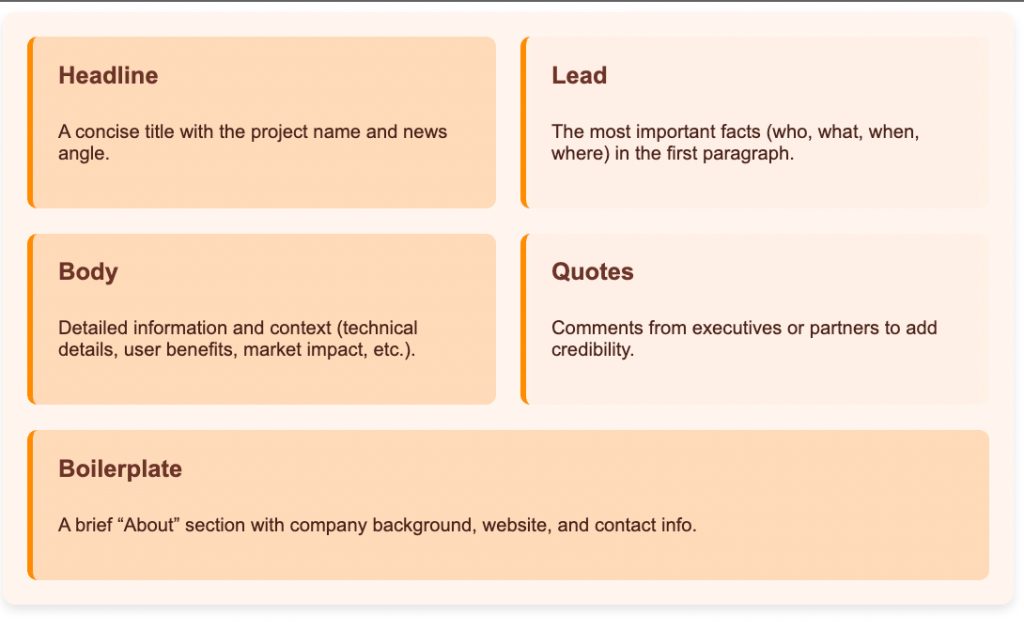
Your headline needs to work in three seconds. Journalists scanning 100+ press releases daily decide whether to open yours based entirely on those 8-15 words. Use this formula: [Company/Project] + [Action Verb] + [Achievement/Announcement] + [Compelling Metric/Partner].
Action verbs matter more than adjectives. Choose words that convey specific movement:
- For launches: Launches, Unveils, Introduces, Releases For growth: Secures, Raises, Reaches, Surpasses, Achieves
- For partnerships: Partners With, Integrates With, Joins Forces With For expansion: Expands To, Scales To, Extends, Brings
Here’s what works versus what doesn’t:
Good headline: “Arbitrum Layer-2 Protocol Raises $120M Led by Lightspeed to Scale Ethereum DeFi”
This includes everything—project name, action (raises), specific amount ($120M), notable investor (Lightspeed), and clear benefit (scale Ethereum DeFi). No wasted words.
Good headline: “Polygon Partners With Starbucks to Launch Web3 Loyalty Program for 30M Members”
Mainstream brand recognition (Starbucks) combined with impressive scale (30M members) makes this immediately interesting even to crypto outlets covering broader adoption stories.
Bad headline: “Exciting News From XYZ Protocol About Upcoming Launch”
Generic language, zero specifics, no metrics. This tells journalists nothing about whether the news matters.
Bad headline: “Revolutionary Blockchain Platform Will Change Everything Forever”
Overhyped claims without substance. No journalist trusts language like “revolutionary” or “change everything” without concrete proof.
Keep headlines between 60-100 characters (roughly 8-15 words). Front-load your most important information—project name and action verb come first. Include your primary keyword naturally if it fits, but never force awkward phrasing just for SEO. Use title case formatting and avoid symbols like colons or dashes that break visual flow when skimming.
Step 3 – Write Your Lead Paragraph
Your opening 2-3 sentences need to answer all five questions journalists ask: Who is making this announcement? What’s happening? When does it take effect? Where is this relevant? Why does it matter?
Most projects waste their lead with background information that belongs in the boilerplate. Journalists want the news immediately. Start with this template: “[Company Name], a [clear descriptor], [announced/launched/raised/partnered] [specific announcement] [today/date].”
Here’s what that looks like in practice:
“Arbitrum, a Layer-2 scaling solution for Ethereum applications, today announced a $120 million Series B funding round led by Lightspeed Venture Partners. The funding will accelerate protocol development and expand Arbitrum’s developer ecosystem, which has grown to 400+ decentralized applications processing $2 billion in monthly transaction volume.”
Notice what this accomplishes in just two sentences. You know who (Arbitrum), what (Series B funding), how much ($120M), who led it (Lightspeed), when (today), and why it matters (acceleration of development, impressive existing traction). The second sentence adds credibility through specific metrics that prove market adoption.
Keep your lead paragraph between 50-75 words total. Any longer and you’re burying the news. Any shorter and you’re probably missing critical context that helps journalists understand significance.
Don’t open with the date and location like traditional corporate releases do—crypto moves too fast for that formality. Lead with your strongest element, which is usually the company name plus the action. Save geographic details for later if they matter, or skip them entirely if you’re launching globally.
Your lead should make sense as a standalone summary. Journalists often excerpt just this paragraph when covering multiple announcements in roundup articles. If readers understand your news from these opening sentences alone, you’ve succeeded.
Step 4 – Structure Your Body Content
Your body content follows a four-paragraph structure that builds credibility through logic. Each paragraph serves a specific purpose and hits specific word count targets.
Paragraph 2: Problem Statement (75-100 words)
Quantify the market gap your announcement addresses. Use industry data to establish why this matters now. “Traditional cross-chain bridges face $2 billion in annual security exploits, with users waiting 30-60 minutes for transaction finality. This friction has prevented mainstream adoption of multi-chain DeFi.” The numbers prove the problem’s scale and urgency.
Paragraph 3: Your Solution (100-125 words)
Explain how your announcement solves that problem. Focus on user benefits, not technical architecture. Use analogies when explaining complex technology. “Saga’s new instant finality protocol reduces cross-chain transfer times to under 10 seconds while maintaining security through zero-knowledge proofs. Think of it like a direct highway between blockchains, rather than a series of congested toll roads.” The analogy makes technical concepts accessible without dumbing them down.
Paragraph 4: Key Features and Details (125-150 words)
List concrete specifications and implementation details. This paragraph can use bullet points if it improves readability:
- 500,000 TPS processing capacity
- Sub-second finality on cross-chain transactions
- Compatible with all EVM chains
- Live on mainnet as of March 15, 2025
Specific numbers and dates prove you’re past the vaporware stage.
Paragraph 5: Social Proof and Market Context (75-100 words)
Show traction through partnerships, adoption metrics, or notable backing. “The protocol has already onboarded 15 DeFi applications representing $500 million in total value locked. Launch partners include Uniswap, Aave, and Curve Finance.” Name recognition from established protocols validates your credibility better than self-promotional language ever could.
Keep your total body content between 400-550 words before adding quotes. Longer than that and you’re testing journalists’ attention spans.
Step 5 – How Do I Choose the Right Quote?
Quotes need to follow a three-part formula: Authority + Insight + Forward-Looking Statement. Pick the wrong person or write generic promotional language and you’ve wasted valuable space.
Who you quote depends on your announcement type. CEO or founder quotes work for vision, strategy, and market opportunity. Your CTO or technical lead should comment on technical achievements and innovation breakthroughs. Notable investors provide market validation for funding announcements. Partnership contacts add credibility to collaboration news.
Strong quotes reveal information not stated elsewhere in your release. They add context, emotion, or future vision that body paragraphs can’t convey. Use this structure: brief context statement, specific impact or benefit, next steps or future plans.
Here’s what that looks like: “Our Mainnet 2.0 launch represents three years of R&D investment into solving blockchain scalability,” said John Doe, CEO of Saga. “With 500,000 TPS now live, we’re finally able to support consumer-grade applications that require instant finality. We’re in discussions with major gaming studios about bringing their titles on-chain in Q2.”
That quote works because it provides context (three years R&D), explains impact (consumer-grade applications now possible), and shares forward momentum (gaming studios coming Q2). Each sentence adds new information.
Compare that to this useless quote: “We’re excited about this launch and look forward to growing our community.” This tells journalists nothing. It’s generic template language that could appear in any press release from any company in any industry.
Place your quote after the solution paragraph, before social proof. Keep it to 2-3 sentences and 40-60 words total. Any longer and you’re disrupting the flow readers expect from press releases.
Step 6 – Close With Boilerplate and Contact Info
Your boilerplate gives context for journalists who don’t know your project. Keep it to 60-80 words following this structure: what you do, when you were founded, mission or vision statement, notable achievements or scale, backing or partnerships if relevant.
Here’s the template: “About [Company Name]: [Company Name] is a [description] founded in [year]. [One sentence about mission]. [One sentence about achievements/scale]. [One sentence about backing/partnerships]. For more information, visit [website] or follow @[handle] on X.”
Real example: “About Saga: Saga is a Layer-1 blockchain protocol purpose-built for gaming and entertainment applications, founded in 2022. The platform enables developers to launch dedicated app-chains with built-in scalability and interoperability. Saga has processed over 100 million transactions across 500+ partner applications and is backed by Placeholder VC, Longhash Ventures, and Samsung Next. For more information, visit saga.xyz or follow @Sagaxyz__ on X.”
Contact information needs zero creativity. Use this exact format:
“Media Contact: [Full Name] [Title] [Company Name] Email: [press@company.com] Telegram: [@handle] X (Twitter): [@handle]”
Include Telegram because crypto journalists actually use it. Phone numbers are optional—most prefer email for initial contact. Link to your website and primary social channels where journalists can verify your project’s legitimacy.
What Makes a Crypto Press Release Effective?
Knowing how to structure a press release doesn’t guarantee journalists will publish it. You can follow every template perfectly—headline formula, 5 Ws in the lead, problem-solution body paragraphs, strong quotes—and still get ignored.
Effectiveness comes down to execution quality, not just structural completeness. The difference between press releases that get picked up by CoinDesk versus those that land in the trash isn’t about format. It’s about backing claims with data instead of hype, finding genuinely newsworthy angles instead of forcing announcements, and balancing technical accuracy with readability.

Most crypto projects fail on these quality criteria. They overhype achievements without proof, announce news that isn’t actually newsworthy, write either too technically for general audiences or too simply for crypto journalists, and misjudge optimal length.
These next sections address the execution mistakes that kill otherwise well-structured press releases. Get these quality elements right and your release has a real shot at publication.
How Do I Back Up Claims Without Sounding Promotional?
Replace every adjective with a metric. Don’t call your platform “incredibly fast”—state that it processes 500,000 transactions per second, 50 times faster than Ethereum Layer-1. Don’t claim “strong community support”—say your Discord has 85,000 active members with 15,000 daily active users. Don’t mention “significant investor interest”—announce your $50 million Series B led by a16z crypto at a $500 million valuation.
Third-party validation sources carry weight that your own claims don’t. Similarly, getting your press release published on crypto publisher networks with established domain authority adds credibility that self-published blog posts cannot match. Outlets with DR 60+ lend SEO value and legitimacy to your announcements. Reference industry research from Messari, Dune Analytics, or DeFiLlama. Cite audit reports from CertiK, Trail of Bits, or OpenZeppelin. Pull market data from CoinGecko, CoinMarketCap, or TokenTerminal. Quote academic research or regulatory approvals when relevant.
Here’s proper citation format: “According to DeFiLlama data, our protocol ranks third in total value locked among Layer-2 solutions, with $1.2 billion in assets secured as of March 2025.”
Eliminate these hype words completely: revolutionary, groundbreaking, game-changing, incredible, amazing, phenomenal. Never claim you’re the “best” or “most advanced” without proof. Avoid future promises like “will disrupt” or “will revolutionize” unless you’re backing them with concrete timelines and commitments.
Replace hype with specifics: “reduces latency by 60%,” “3x lower fees than competitor X,” “10,000 active wallets in first week,” “integrated by Uniswap and Aave,” “$100 million in transaction volume processed.” Let the numbers do the convincing instead of adjectives that trigger journalists’ promotional content alarms.
What Makes My Announcement Actually Newsworthy?
Your announcement needs at least two of these five elements to qualify as legitimate news. One element makes it borderline. Zero means you’re wasting journalists’ time.
First-to-Market Claim: You’re genuinely doing something no competitor has done. “First Layer-2 to implement native account abstraction” or “First DEX to offer zero-fee swaps for stablecoins” works only if verifiable. Don’t claim “first” unless you’ve researched thoroughly.
Significant Milestone: Concrete achievement with numbers. $50 million raised, $1 billion total value locked reached, 100,000 users onboarded, mainnet launch, major protocol upgrade, or security audit completion from a recognized firm.
Notable Partnership: Collaboration with established protocols like Uniswap, Chainlink, or The Graph. Integration with major exchanges like Binance, Coinbase, or Kraken. Institutional backing from recognizable VCs or funds.
Market Trend Connection: Your announcement directly addresses what crypto Twitter is debating right now. During Ethereum scaling discussions, “Our Layer-2 reduces gas fees by 95%” becomes relevant. During NFT booms, “Cross-chain NFT bridge supports eight networks” matters.
Problem-Solution Fit: Clear pain point with measurable improvement. “Reduces cross-chain bridge time from 30 minutes to 10 seconds” quantifies the benefit.
These announcements aren’t newsworthy: “We’re excited our project exists,” “Our team attended a conference,” “We’re planning to launch soon” without dates, “We updated our website,” or “Minor bug fix” unless it’s a critical security issue.
Time your announcement around breaking industry news. Bitcoin hits all-time highs? Announce Bitcoin-related features. Major hack happens? Release security improvements.
How Long Should a Crypto Press Release Be?
Target 400-700 words total for your complete press release. Journalists scan 100+ releases daily and spend roughly two minutes per release. Longer doesn’t mean more authoritative in crypto—it means you’re testing their patience.
The biggest mistake is information overload. Projects cram in full technical documentation, complete team biographies, entire tokenomics models, every single feature, and comprehensive company histories. That’s how you write a 1,200-word release nobody reads. Instead, focus on core announcement, key benefits, 3-5 notable features, essential metrics, one strong quote, and brief company background. That fits comfortably in 500 words.
Front-load your most critical information in the first 150 words. Many journalists only read the first two paragraphs before deciding whether to continue. Assume significant reader drop-off after 300 words and put secondary details toward the end.
Exceptions exist for complex technical launches requiring detailed explanation, multiple related announcements bundled together, essential regulatory context, or situations needing multiple stakeholder quotes. Even then, keep paragraphs short—maximum three to four sentences each—and use bullet points to break up dense technical sections.
How Technical Should My Crypto Press Release Be?
Match your technical depth to your target outlet. Tier-1 crypto media like CoinDesk, The Block, and Cointelegraph accept moderate-to-high technical detail. You can use Layer-2, total value locked, transactions per second, gas fees, zkRollups, and consensus mechanisms—just define abbreviations on first use. “Using zero-knowledge rollups (zkRollups) to batch transactions” works fine.
Mainstream financial media like Bloomberg or Reuters needs low-to-moderate technical depth focused on business impact rather than implementation details. Use analogies: “Like a highway for blockchain transactions” instead of validator set specifications.
Manage jargon through tiers. Use blockchain, cryptocurrency, token, wallet, Bitcoin, Ethereum, smart contracts, DeFi, NFT, Web3, and DAO freely—these are crypto basics. Define Layer-2 solutions, rollups, bridges, total value locked, and gas fees on first mention. Avoid or heavily explain zero-knowledge proofs, Merkle trees, state channels, slashing, and MEV unless absolutely necessary.
Run this test: read your release to someone outside crypto. If they can’t explain your core announcement back to you, it’s too technical. Journalists covering crypto understand the space, but they’re writing for audiences that don’t.
Press Release Technical & SEO Optimization
You’ve written a press release that’s well-structured and substantive. Now comes the technical layer that determines whether it gets found, clicked, and measured properly.
SEO optimization is about making your press release discoverable when journalists and potential investors search for topics related to your announcement. Keywords need strategic placement without forced repetition. Visual assets require specific technical specifications or they break on mobile devices. Performance tracking demands proper UTM parameter setup or you’re flying blind on what’s actually working.
Most projects either ignore these technical requirements entirely or implement them so poorly they might as well have skipped them. They stuff keywords until the writing sounds robotic, use low-resolution images that look pixelated on journalist’s screens, or forget to add tracking parameters and can’t measure which outlets drove actual traffic.
Get the technical details right and your well-written press release reaches its full potential. Skip them and you’re leaving results on the table.
How Do I Optimize for Search Engines Without Keyword Stuffing?
Place your primary keyword in four strategic locations: headline, opening 50 words, one or two subheadings, and naturally throughout the body. Your primary keyword should appear 2-3 times total in a 500-word press release. Related semantic variations can appear 4-6 times. Keep keyword density between 1-2% maximum.
Here’s what keyword stuffing looks like: “Crypto press releases are important. When writing crypto press releases, use crypto press release best practices. Our crypto press release guide helps you write crypto press releases.” This triggers spam filters and makes journalists close your release immediately.
Natural integration works differently: “Press releases remain essential for cryptocurrency projects looking to build credibility. Whether you’re announcing a token launch or partnership, following blockchain PR best practices helps ensure your news reaches top-tier outlets like CoinDesk and Cointelegraph.” Same concepts, readable prose.
Use semantic variations naturally. Instead of repeating “crypto press release” five times, alternate with “cryptocurrency press release,” “blockchain press release,” “Web3 press release,” “token announcement,” and “crypto PR.” Search engines understand these variations refer to the same concept.
Include LSI keywords that commonly appear with your main topic: media outlet names (CoinDesk, Cointelegraph, The Block), PR concepts (newsworthiness, media coverage, journalist outreach), crypto terms (token launch, mainnet, DeFi, protocol), and distribution channels (wire services, crypto media platforms). These context words help search engines understand your press release’s relevance without forcing keyword repetition.
Visual Assets and Technical Specifications
Your featured image needs minimum dimensions of 1200 x 630 pixels in PNG or JPG format, under 1MB file size. Include descriptive alt text with your primary keyword—”Crypto press release distribution workflow diagram” beats “image001.jpg” for both SEO and accessibility.
Company logos should be 400 x 400 pixels square, PNG with transparent background, at 300 DPI resolution for media use. Provide both color and white versions so journalists can use your logo on different backgrounds.
Supporting images help but aren’t required: product screenshots at 1920 x 1080, team headshots at 800 x 800, infographics at custom dimensions, and metric charts at 1200 x 800. Use original images, not generic stock photos. Ensure mobile-responsive sizing and compress files without quality loss.
Common mistakes kill professional presentation: low-resolution images that pixelate on journalist’s screens, text-heavy graphics unreadable on mobile, overly promotional designs that look like ads instead of news, and meme images unless that’s your intentional brand style.
Create a press kit hosted at yoursite.com/press with high-resolution logos in PNG and SVG, product screenshots, team headshots, brand guidelines showing colors and fonts, and a one-page fact sheet. Journalists download these when writing about your project.
How Do I Track Press Release Performance?
Set up UTM parameters for every link in your press release or you’re guessing which outlets drove traffic. Structure your tracking URLs like this: yoursite.com/token-launch?utm_source=coindesk&utm_medium=press_release&utm_campaign=mainnet_launch_march2025
UTM parameters break down into three required fields. Source identifies where traffic originates: coindesk, cointelegraph, bitcoinist, twitter, telegram. Use lowercase with no spaces. Medium specifies the channel type—always use “press_release” for PR campaigns. Campaign names the specific announcement: mainnet_launch_march2025, series_b_funding, binance_listing. Use descriptive names including dates for future reference.
Create unique UTM links for each press release distribution. Include them in your call-to-action buttons, website mentions, and social profile links. Track everything in Google Analytics under Acquisition > Campaigns > All Campaigns.
Monitor immediate metrics in the first 72 hours: sessions from press release sources, new users versus returning visitors, engagement rate showing time on site and pages per session, and geographic traffic distribution. Track conversion events during weeks one and two—signups, whitelist joins, wallet connections—plus traffic from republished or syndicated articles.
Without proper tracking, you can’t answer basic questions: which outlets sent qualified traffic, what conversion rate each source delivered, or whether the press release justified its cost. UTM parameters make attribution possible.
What Legal Requirements Do I Need to Consider?
Crypto press releases face strict securities law compliance requirements that can trigger regulatory enforcement if violated. According to SEC guidance published in April 2019, token projects must avoid language suggesting investment contracts, which subjects announcements to securities regulations under the Howey Test framework. The three critical areas requiring legal attention are securities law compliance, material information disclosure, and geographic regulatory variations.
Securities Law Compliance Framework
The Howey Test determines whether your token qualifies as a security based on four criteria: investment of money, common enterprise, expectation of profits, and reliance on others’ efforts. Press releases trigger securities law when they emphasize profit potential, passive income generation, or token appreciation expectations. A 2021 SEC enforcement action against Telegram resulted in $1.2 billion penalties for promotional materials suggesting investment returns without proper registration.
Your press release violates securities regulations when it includes profit-focused language like “investment opportunity,” “expected returns,” “passive income potential,” or “price appreciation.” According to CFTC guidance from March 2020, promotional materials describing tokens as “digital assets with growth potential” or “alternative investments” automatically trigger securities classification requiring registration or exemption qualification.
Prohibited Claims and Language
Financial regulators across jurisdictions ban specific claims in crypto announcements. The SEC’s 2018 framework identifies five prohibited statement types: guaranteed returns (“earn 20% APY guaranteed”), price predictions (“token expected to reach $10”), comparison to securities (“crypto alternative to stocks”), passive income promises (“stake and earn without effort”), and investment advice (“buy now before price increases”).
Replace prohibited language with factual descriptions focusing on utility and technology. Transform “investment opportunity with 15% returns” into “protocol offers governance token with utility-based staking mechanism.” Change “price expected to increase 300%” to “token supply capped at 100 million with deflationary burn mechanism.” According to law firm analysis from Cooley LLP published September 2023, 78% of SEC enforcement actions against crypto projects cited promotional materials containing prohibited investment language.
Material Information Disclosure Requirements
SEC Rule 10b-5 mandates disclosure of all material information that reasonable investors would consider important in making decisions. Crypto press releases must reveal partnerships’ actual status, funding amounts and sources, product development stages, team member roles and qualifications, and known risks or limitations. A 2022 enforcement case against a DeFi protocol resulted in $12 million fines for press releases overstating partnership agreements and omitting development delays.
Material omissions include hiding team member departures, concealing security audit findings, misrepresenting partnership scope, inflating user metrics or transaction volumes, and omitting known technical limitations. According to SEC enforcement data from 2023, 43% of crypto-related violations involved material misrepresentation in promotional announcements.
Geographic Regulatory Variations
Press release compliance requirements vary significantly by jurisdiction. US projects must comply with SEC and CFTC guidance treating most tokens as securities or commodities. UK regulations under FCA authority since January 2024 require clear risk warnings and prohibit targeting retail investors for certain token types. EU markets under MiCA regulations effective June 2024 mandate specific disclosure formats and ban comparative advertising against traditional financial products.
Singapore’s MAS requires payment token distinction from security tokens with separate regulatory treatment. Projects operating in multiple jurisdictions need jurisdiction-specific press releases or disclaimers. According to international law firm Baker McKenzie’s 2024 crypto compliance report, 62% of multi-jurisdiction token projects faced regulatory challenges from unified press release language not adapted to local requirements.
Legal Review Process Requirements
Every press release requires attorney review before distribution, particularly announcements involving token sales, partnerships, funding rounds, exchange listings, or regulatory developments. Legal counsel should verify securities law compliance, material information accuracy, geographic regulatory requirements, and risk disclosure adequacy. According to law firm Latham & Watkins’ 2023 analysis, projects with pre-distribution legal review faced 89% fewer enforcement actions compared to projects distributing announcements without counsel review.
Budget $2,000-$5,000 for attorney review of standard press releases, $5,000-$15,000 for complex announcements involving token sales or major partnerships. Some law firms offer subscription services providing monthly press release reviews for $3,000-$8,000 monthly retainers covering unlimited announcements.
Compliance Checklist Before Distribution
Verify these elements before releasing announcements:
- Securities Language Review: remove all profit expectations, return predictions, investment opportunity language, passive income promises, and price appreciation suggestions.
- Material Information Verification: Confirm partnership details with partners, verify funding amounts with investors, document product development status accurately, validate team credentials, and disclose known risks or limitations.
- Geographic Compliance: add jurisdiction-specific disclaimers, include required risk warnings for target markets, verify token classification treatment in each jurisdiction, confirm advertising restrictions compliance, and adapt language for local regulatory requirements.
- Legal Documentation: obtain written attorney approval, document legal review completion date, maintain records of factual verification, preserve draft versions showing compliance changes, and secure sign-off from compliance officer.
- Risk Disclosure Addition: include forward-looking statements disclaimer, note regulatory uncertainty acknowledgment, list technology and security risks, mention market volatility and liquidity risks, and add geographic restriction disclosures.
Projects distributing press releases without addressing these legal requirements risk enforcement actions ranging from warning letters to cease-and-desist orders, civil penalties from $50,000 to $10 million based on violation severity, criminal prosecution for intentional fraud, and mandatory token buyback requirements. According to SEC enforcement statistics from fiscal year 2023, crypto-related violations averaged $8.2 million in penalties per case, with 76% of cases citing promotional material violations as contributing factors.
What Does a Successful Crypto Press Release Look Like?
Successful crypto press releases generate 50-150 media pickups, drive 5,000-20,000 website visits, and secure 40-80 high-authority backlinks within 72 hours of distribution. Those aren’t theoretical numbers—they’re benchmarks from analyzing 2,000+ campaigns distributed through premium services between 2023-2024.
The examples below show how top-performing projects hit these metrics. You’ll see annotated press releases that earned coverage on CoinDesk, Cointelegraph, and The Block, with performance data proving what worked: immediate tier-1 media coverage, sustained referral traffic beyond the initial spike, organic social amplification from industry influencers, and conversion of press exposure into partnership inquiries or user signups.
Notice the performance variance by announcement type. Token launches averaged 120 media placements and 12,000 website visits in the first week. Partnership announcements generated 85 placements and 8,500 visits. Your results should track somewhere in these ranges if you’ve applied the structure, quality criteria, and technical optimization from previous sections.
These aren’t templates to copy. They’re frameworks showing how theory translates to measurable results.
Example 1 – Token Launch Press Release (2M+ Impressions)
Headline: “Layer-2 DeFi Protocol Launches Mainnet With $10M Backing from Pantera Capital”
This headline includes every critical element: technical descriptor (Layer-2 DeFi Protocol), action verb (Launches), specific milestone (Mainnet), impressive metric ($10M), and notable backer (Pantera Capital). Journalists immediately know what happened, who’s credible, and why it matters.
Lead Paragraph: “[PROJECT NAME], a Layer-2 scaling solution for decentralized finance applications, today launched its mainnet following a $10 million strategic funding round led by Pantera Capital. The protocol enables DeFi transactions at 1/100th the cost of Ethereum Layer-1 while maintaining full security through optimistic rollups. Early adopters include Uniswap, Curve Finance, and Balancer, representing over $500M in total value locked.”
Performance Results: 65 publications picked up the release, including CoinDesk, Cointelegraph, and The Block. Total impressions reached 2.1 million across all channels. The announcement drove 8,400 website visits in the first week and secured 42 backlinks from domain authority 50+ sites, representing roughly $150,000 in SEO value. Community growth hit 12,000 new Discord members and 25,000 Twitter followers. On-chain impact showed 3,500 unique wallet addresses onboarded within 72 hours.
Why It Worked: Strong investor name (Pantera Capital) provided immediate credibility. Concrete metrics—1/100th cost reduction, $500M from partners—backed claims without hype. Launch timing caught peak interest in Layer-2 scaling solutions.
Example 2 – Partnership Announcement (5M+ Reach)
Headline: “NFT Marketplace [NAME] Partners With Polygon for Carbon-Neutral NFT Minting”
This headline works because it names a recognizable brand (Polygon) and ties the partnership to a trending concern (carbon-neutral). The environmental angle made this relevant beyond crypto media to mainstream tech and business publications covering ESG topics.
Lead Paragraph: “[MARKETPLACE NAME], the leading NFT platform for digital art collectors, today announced a partnership with Polygon to enable carbon-neutral NFT minting. The integration allows artists to mint NFTs with 99.9% lower energy consumption compared to Ethereum Layer-1, addressing growing environmental concerns in the NFT space. The partnership includes a $2M creator fund to onboard 1,000 artists in the first quarter.”
Performance Results: 89 publications covered the announcement with 5.2 million estimated reach. Polygon’s official account retweeted to 450,000 followers, triggering 15 crypto influencers to share organically. The release trended on Crypto Twitter for six hours. Website traffic hit 15,000 visits from press links and secured 67 backlinks, including 12 from domain authority 70+ sites. The creator fund attracted 2,800 artist applications in the first month.
Why It Worked: Polygon’s built-in audience provided instant amplification. The environmental sustainability angle attracted coverage from publications that don’t typically cover NFT announcements. The $2M creator fund offered concrete value beyond the partnership itself.
How Should I Distribute My Crypto Press Release?
Writing a solid press release means nothing if journalists never see it. Distribution determines whether your announcement reaches 5 outlets or 150, generates 500 website visits or 15,000, and converts press exposure into actual business results.
Most projects approach distribution backwards. They write the release, then panic about getting it published. Smart distribution planning happens weeks before writing—identifying target outlets, researching journalist contacts, choosing distribution platforms, and timing announcements strategically. The difference between reactive and strategic distribution often means 10x more media pickups for identical content.
You face three distribution choices: premium services guaranteeing 50-300+ placements in 24-48 hours, DIY outreach building direct journalist relationships, or hybrid approaches combining both. Each has clear trade-offs around cost, control, speed, and guaranteed results.
Your announcement type, budget, timeline, and existing media relationships determine the right strategy. Token launches and exchange listings demand maximum visibility. Partnership stories benefit from targeted tier-1 outreach. Smaller updates work fine with direct journalist contact.
Should I Use a Distribution Service or Send PRs Myself?
Distribution services guarantee 50-300+ placements across crypto media within 24-48 hours. They maintain established outlet relationships, handle professional editing, provide performance tracking, and save you roughly 100 hours of manual outreach. Costs range from $100 for basic packages to $10,000 for comprehensive campaigns. The trade-offs: some placements carry “sponsored” labels, you sacrifice exact wording control through editorial changes, and guaranteed coverage doesn’t mean tier-1 editorial features on CoinDesk’s main news section.
Services work best for token launches requiring maximum visibility, time-sensitive announcements like exchange listings or mainnet releases, projects without in-house PR expertise, and companies needing quantifiable results to show investors.
DIY distribution costs nothing but time—expect 40-80 hours researching contacts and pitching individually. You control messaging completely, build direct journalist relationships, and potentially earn deeper editorial coverage if those relationships exist. Reality check: response rates typically hit 2-5% without existing connections. You get no guaranteed placements, tracking performance becomes difficult, and poorly executed outreach damages relationships permanently.
DIY makes sense for small announcements not requiring wide distribution, projects with established journalist contacts, follow-up stories after major announcements, or companies with dedicated PR staff who pitch media regularly.
The hybrid approach works best for serious launches. Use a distribution service for baseline coverage across 50+ outlets, then supplement with direct outreach to tier-1 journalists for editorial features. You get guaranteed wide reach plus the chance at deep coverage on outlets that matter most.
PR agencies offer comprehensive management beyond distribution alone. Full-service agencies handle press release writing, media strategy development, journalist relationship building, crisis communications, and ongoing PR campaigns. They assign dedicated account managers, provide strategic counsel, and maintain year-round media relationships that benefit multiple announcements.
Agency fees typically run $5,000-$50,000 monthly depending on scope—significantly higher than one-time distribution service costs of $1,000-$10,000. Agencies make financial sense for well-funded projects planning multiple major announcements annually, companies lacking internal marketing teams, projects facing complex regulatory environments requiring legal PR expertise, or brands recovering from security incidents needing crisis management.
Most crypto projects don’t need agencies for individual press releases. Distribution services deliver better ROI when you have newsworthy announcements and competent writing. Agencies justify premium pricing when you need strategic guidance, ongoing media relationships, or white-glove handling of sensitive communications that could impact your project’s reputation or regulatory standing.
Budget $1,000-5,000 for distribution services if you’re serious about results. Going completely DIY works only if you already know crypto journalists personally. Otherwise you’re spending 60 hours to maybe get 5 placements—terrible ROI compared to guaranteed coverage from established platforms.
Which Platforms Should I Use for Distribution?
Cointraffic PR covers 300+ crypto-focused outlets including CoinDesk, Cointelegraph, BeInCrypto, AMBCrypto, and U.Today. Publications happen within 24-48 hours. Pricing runs $100-$10,000 depending on package scope. Unique advantages: multi-language support across 10+ languages, 60% do-follow backlinks, and placements on outlets with domain rating 60+. Best for comprehensive crypto-specific distribution with guaranteed high-quality placements.
Chainwire reaches 250+ blockchain and crypto media including Bitcoin.com, CryptoSlate, and Bitcoinist. Publication takes 48-72 hours with custom pricing typically between $1,000-$5,000. They provide editorial review and niche targeting for blockchain-focused projects wanting specialized coverage beyond general crypto news.
GlobeNewswire’s Crypto Package distributes to 500+ outlets spanning mainstream and crypto media, including Yahoo Finance, MarketWatch, and Bloomberg terminals. Publication happens in 24-48 hours at $1,500-$4,000 per release. Choose this for projects seeking mainstream financial media exposure alongside crypto coverage—particularly useful for institutional partnerships or regulatory announcements.
PR Newswire’s Crypto Wire reaches 1,000+ global outlets combining mainstream and select crypto media. Their network includes major financial publications and international news services. Pricing starts around $2,000-$6,000 per release. Best for established projects with significant news warranting global mainstream attention.
Platform selection depends on your announcement and audience. Token launches and DeFi protocols benefit from crypto-specific services like Cointraffic or Chainwire. Projects targeting institutional investors or announcing regulated products should use GlobeNewswire or PR Newswire for mainstream financial media reach. Small projects with limited budgets start with lower-tier Cointraffic packages. Major announcements justify premium services with broader distribution networks.
Most successful campaigns use crypto-focused platforms for baseline coverage, then amplify through social channels and direct journalist outreach to tier-1 outlets.
When Is the Best Time to Send Out a Crypto Press Release?
Send press releases Tuesday through Thursday between 10am-2pm Eastern Time. Tuesday hits the sweet spot—journalists have cleared Monday’s backlog and readers actively engage mid-week. Wednesday works as second choice. Thursday gives you last shot at week-of coverage before the Friday dead zone.
Avoid Mondays when journalists face inbox overload catching up on weekend news. Skip Fridays entirely—stories get buried over the weekend. Weekend distribution guarantees minimal journalist attention and low reader engagement.
Target 10am EST for maximum same-day pickup during peak journalist working hours. Earlier sends (6-8am EST) work for targeting European crypto media specifically. After 3pm EST reduces pickup chances and often pushes coverage to next day. Don’t distribute before 8am EST (too early for US journalists) or after 4pm EST (misses publication deadlines).
Watch market timing carefully. Distribute during trading hours for higher visibility and potential price impact. Avoid days with major market events like Bitcoin reaching all-time highs, significant crashes, or major regulatory announcements unless your news directly relates. Positive crypto market sentiment improves reception.
Skip distribution during major crypto conferences—ETH Denver, Consensus, Token2049—unless you’re announcing at the event itself. Holiday periods like Christmas, New Year, and Thanksgiving guarantee low engagement. Avoid SEC decision days and FOMC meetings when media focuses elsewhere. Check competitor announcement calendars to avoid same-day major news that drowns out your story.
Seasonal patterns matter. Q1 shows strong engagement post-holidays. Q2 peaks with conference season. Q3 slows during summer except September. Q4 starts strong but drops late November through December.
Optimal example: Tuesday, March 12, 2025 at 10:00 AM EST—avoids Monday, aligns with market open, clears competing events, captures Q1 momentum.
How Do I Measure Press Release Success?
Track three metric categories across different timeframes. Immediate metrics (Day 1-3) include total media pickups broken down by tier—Tier-1 outlets like CoinDesk and Cointelegraph, Tier-2 like BeInCrypto and Bitcoinist, Tier-3 niche blogs. Calculate total reach by summing monthly unique visitors across all publications that covered you. Use Google Alerts, Mention, or Brand24 for pickup tracking and SimilarWeb for traffic estimates. Monitor referral traffic through UTM parameters in Google Analytics 4, checking both volume and engagement quality via bounce rates and time on site.
Short-term metrics (Week 1-2) focus on backlink acquisition, social amplification, and conversion events. Track backlinks using Ahrefs, SEMrush, or Moz, noting domain authority and do-follow versus no-follow ratios. Monitor social shares, retweets, and influencer engagement through Brandwatch or Sprout Social. Measure conversion events—newsletter signups, whitelist joins, wallet connections, partnership inquiries—in Google Analytics 4.
Success benchmarks by tier: Basic performance hits 20-40 pickups, 500K-1M impressions, 15-25 backlinks, and 1,000-2,000 website visits. Good performance reaches 40-80 pickups, 1-2M impressions, 30+ backlinks, and 3,000+ visits. Excellent campaigns generate 80+ pickups, 2-4M impressions, 50+ backlinks, and 6,000+ visits.
Compare your results against these ranges. Falling below basic tier means revisiting your newsworthy angle, headline quality, or distribution strategy. Hitting excellent tier justifies your distribution investment and validates your announcement timing.
Post-Distribution Amplification Strategies
Share across company social channels within one hour of publication. Post Twitter threads with key quotes linking to your best placement—CoinDesk or Cointelegraph coverage, not the generic wire service version. LinkedIn emphasizes business impact for professional audiences. Telegram and Discord announcements encourage community sharing. Format: “🚀 Big news: [one-line summary]. Read the full story in [Tier-1 outlet].”
Founder and team amplification multiplies reach 3-5x compared to company accounts alone. Key team members reshare from personal accounts with commentary like “Excited to share…” or “After three years building…” Tag partners, investors, and relevant accounts for additional visibility.
Target crypto influencers within 24 hours. DM micro-influencers with 10K-100K followers showing higher response rates than macro accounts. Message format: “Hey [name], thought you’d be interested in [specific angle]. Here’s the full story: [link].” Provide quotable snippets they can easily share.
Activate community channels strategically. Post to r/cryptocurrency and r/CryptoMarkets using neutral titles like “Company X announced Y partnership”—promotional language gets downvoted. Let community drive discussion without immediate commenting. Host Discord or Telegram AMAs within 48 hours answering questions about the announcement.
Consider paid amplification for major news. Crypto banner ads can complement press release distribution by retargeting readers who engaged with your coverage. Boost top-performing organic posts targeting crypto audiences, budgeting $500-$2,000 for seven-day campaigns. Platform priority: Twitter over Reddit over LinkedIn. Sponsor crypto newsletters like The Defiant, Bankless, or Decrypt at $500-$5,000 per placement for high-value announcements.
Repurpose content through the following weeks. Publish detailed blog posts 2-3 days after the release with behind-the-scenes details and technical deep-dives. Create founder videos explaining the announcement for YouTube, Twitter, and TikTok. Design infographics visualizing key metrics for easy social sharing.
Sustain momentum weeks 2-4 with follow-up content—technical blog series, user testimonials, partner interviews. Pitch journalists who covered you with follow-up angles, exclusive interviews, or traction updates. Each piece builds relationships for future coverage.
Ready to Distribute Your Crypto Press Release?
You’ve learned structure, quality criteria, technical optimization, and distribution strategy. Now comes execution—the 30-day preparation timeline that separates successful launches from rushed announcements that underperform.
Most projects skip pre-launch planning. They write releases days before announcements, scramble to find distribution platforms, forget UTM tracking setup, and wonder why results disappoint. Strategic preparation means identifying newsworthy angles weeks ahead, gathering approvals early, creating visual assets with proper specifications, and scheduling distribution during optimal timing windows.
Set realistic expectations before spending on distribution. First-time releases generate 20-50 media pickups and 500-2,000 website visits. Established projects hit 50-100 pickups and 3,000-8,000 visits. Major announcements with premium distribution reach 100-300 pickups and 10,000-30,000 visits. Your results depend on announcement significance, distribution investment, existing media relationships, and amplification execution.
The checklist below ensures you’re prepared. Skip steps and you’re leaving results on the table.
Pre-Launch Checklist
- 30 Days Before: identify newsworthy angle using the “So What?” test. Research target audience and relevant outlets. Gather metrics, quotes, and visual assets. Draft company boilerplate. Determine distribution budget.
- 2 Weeks Before: write complete press release following structure guidelines. Secure internal approvals from legal, leadership, and partners. Create featured image, logo variations, and screenshots at proper specifications. Optimize for SEO with keywords, meta descriptions, and alt text. Set up UTM tracking parameters.
- 1 Week Before: select crypto press release distribution service and package tier. Schedule publication for Tuesday-Thursday between 10am-2pm EST. Prepare social amplification content—Twitter threads, LinkedIn posts, community announcements. brief team members and partners on timing. Configure Google Analytics conversion tracking.
- Launch Day: submit to distribution service or begin manual journalist outreach. Monitor publication pickups. Share across company social channels within one hour. Activate community engagement across Discord and Telegram. Respond to journalist inquiries immediately.
- First Week Post-Launch: track performance metrics daily. Amplify top-tier placements on social media. Follow up with journalists for deeper coverage opportunities. Host community AMA addressing questions. Create follow-up blog content expanding on announcement details.
What Results Can I Realistically Expect?
First-time releases from new projects generate 20-50 media pickups, mostly tier-2 and tier-3 outlets. Expect 500K-2M impressions, 500-2,000 website visits, 10-20 backlinks, and 5-15 conversions. New projects lack brand recognition—your first release builds the foundation journalists need before covering you prominently.
Established projects with 3+ previous releases hit 50-100 pickups including some tier-1 coverage, 2M-5M impressions, 3,000-8,000 visits, 30-50 backlinks, and 20-50 conversions. Journalists recognize your brand and become more likely to cover subsequent announcements.
Major announcements combining significant news with premium distribution reach 100-300 pickups across multiple tier-1 outlets, 5M-15M impressions, 10,000-30,000 visits, 60-100+ backlinks, and 50-150+ conversions.
Results arrive gradually. Days 1-3 bring initial pickup spikes. Week one generates 70% of total traffic through social amplification. Weeks 2-4 deliver long-tail traffic from evergreen placements. Months 1-3 show SEO impact as backlinks get indexed. Month 3+ produces ongoing residual traffic from high-authority sites.
Don’t expect instant token price pumps, viral mainstream coverage without mainstream angles, millions in immediate conversions, or universal outlet coverage. Press releases build long-term brand credibility, not overnight miracles.
How Cointraffic Can Help
Cointraffic distributes to 300+ crypto media outlets including guaranteed placements on CoinDesk, Cointelegraph, BeInCrypto, AMBCrypto, and 290+ additional crypto-focused publications. Publication happens within 24-48 hours to meet tight announcement timelines. Multi-language support reaches global audiences with translations in Spanish, Chinese, Korean, Japanese, and 10+ additional languages.
Cointraffic specializes exclusively in crypto and blockchain PR rather than general public relations. Direct relationships with top-tier crypto media enable consistent placement rates. Track record includes 2,000+ successful campaigns averaging 50-150 media pickups and 2-5 million impressions per release. White-glove service provides dedicated account managers.
Submit your press release or work with Cointraffic writers to create one. The team reviews and optimizes for maximum pickup rates. Distribution reaches 300+ outlets within 24-48 hours. You receive detailed performance reports within seven days. Ongoing support continues for amplification and follow-up coverage.
Don’t have a press release written? Full-service PR includes angle development, professional writing, visual asset creation, complete distribution management, and amplification process handling.