How to Promote a Cryptocurrency Exchange: A Practical Marketing Guide for 2026
A practical channel-by-channel guide to growing a crypto exchange in 2026. Crypto-native advertising, SEO, influencer marketing, affiliates, and community building.
How to Promote a Cryptocurrency Exchange
A Practical Marketing Guide for 2026
There are hundreds of active crypto exchanges. Most traders use three. That gap is not a product problem. Exchanges that failed to grow almost always had working technology and real liquidity. What they did not have was a strategy for turning anonymous web traffic into people who actually deposit funds and trade.
The global crypto exchange market was valued at $71.35 billion in 2025 and is projected to reach $260 billion by 2032. Binance controls nearly 40% of spot trading volume. OKX, Coinbase, Bybit, and Kraken own the next tier. The remaining market is being contested by hundreds of platforms, most of which are running the same acquisition playbook and wondering why it is not working.
This guide covers what actually moves the needle, channel by channel, and how to sequence it.
Why Most Acquisition Spend Goes Nowhere
The problem starts with how exchanges measure success. Registrations are easy to count and easy to optimize for. They are also almost entirely useless as a business metric. Revenue requires funded accounts. Funded accounts require users who complete KYC, make a deposit, and place a trade. Most registered users do none of those things.
The crypto exchange funnel leaks at every stage. KYC completion rates on derivatives platforms sit between 40 and 50%. Even on well-optimized consumer exchanges, up to 40% of users who start verification never finish it. Day-30 retention across crypto apps averages 2 to 3%, compared to 11.6% for digital banking. More than 75% of users who will ever become active do so within their first week of registering. After that window closes, reactivation is nearly impossible.
Three things drive most of the drop-off:
- KYC friction. Verification delays that stretch from minutes to days push users out before they ever reach the trading interface. 57% of crypto users are already concerned about how exchanges handle their personal data, and a slow or confusing KYC flow confirms those concerns.
- Cognitive overload. More than 60% of new users lack the confidence to navigate wallets, order types, and fee structures at once. Without in-product guidance, they leave at the first moment of confusion.
- No activation trigger. Most exchanges send nothing after sign-up. No deposit incentive, no follow-up email, no reason to return.
Understanding this funnel matters for every marketing decision. It explains why campaigns that generate thousands of clicks sometimes produce almost no active traders. The issue is rarely the channel. It is what happens after the click.
Advertising in the Right Place
Google and Meta have made crypto advertising genuinely unreliable. Certification requirements, shifting regional policies, and opaque enforcement decisions mean that even compliant campaigns get rejected. Most crypto exchanges eventually stop trying to make mainstream ad platforms work and look for alternatives.
The better option is advertising where the audience already is. A user reading price data on CoinGecko, tracking a wallet on Etherscan, or following market news on Cointelegraph is not a general internet visitor. They hold crypto, they trade, and many of them are actively looking for a platform to move to. Reaching that person through a banner on a general news site is expensive and imprecise. Reaching them on the site they are already using for crypto research is neither.
Cointraffic has been operating in this space since 2014 and connects exchanges with 700+ publishers, including CoinMarketCap, CoinGecko, Cointelegraph, Etherscan, Blockchair, BeInCrypto, and CryptoCompare. Campaigns start from €3,000. Four formats are available, each suited to a different point in the acquisition process.
Display Ads
Banner placements in HTML5, GIF, JPG, and PNG formats, positioned above the fold on desktop and in high-visibility slots on mobile. CPM starts from €5. Targeting is available by geography, device type, and publisher website. An exchange running a regional launch in Southeast Asia can target mobile users in specific countries only. An exchange promoting a new derivatives product in Europe can concentrate desktop spend on trading and analytics platforms without touching news inventory. Display works best for sign-up bonus campaigns, token listing announcements, and fee promotions where the message is simple and the goal is volume.
Native Ads
Placements that integrate directly into the publisher site, matching its editorial look and feel. Native ads drive higher CTR than standard display because they do not register as advertising to a user scanning a page. For exchanges, the right destination for this traffic is not a generic homepage but a page that answers the specific question the user is asking: how fees compare, what assets are available, what the security model looks like. Targeting is available by geography and device type.
Crypto & Bitcoin PR Distribution
Press release distribution across up to 150 crypto and Bitcoin-related websites, selected through a publisher constructor that ranks outlets by traffic, visibility, and performance. Content is created or proofread on day one, distributed across selected publishers on days two through four, and followed by a full report with publication links and reach numbers on day five. Distribution is available in up to 10 languages, including Chinese, Portuguese, German, Korean, and Russian. For an exchange announcing a new licensed product, entering a regulated market, or launching in a new region, PR distribution produces coverage that generates backlinks and ranks in search long after the campaign ends.
Marketplace
Direct access to premium placements on individual top-tier publishers, purchased outside the network. This is for exchanges that need a specific slot at a specific moment: the CoinMarketCap homepage during a major listing, a fixed position on Cointelegraph for a product launch, a prominent placement on Etherscan for sustained brand presence. Marketplace placements carry more weight than network-distributed inventory because the publisher, the placement position, and the audience are defined precisely in advance, not allocated by an algorithm.
Content That Keeps Working After You Stop Paying
Every paid channel stops the moment the budget does. Content keeps working. An exchange that builds search authority in year one is still generating organic traffic in year three with no incremental spend. That compounding effect is what makes content worth investing in early, even though results take months to materialize.
The search demand is substantial. Queries like “best crypto exchange for beginners,” “lowest trading fees crypto,” and “how to trade Bitcoin futures” collectively drive millions of searches every month. Ranking for a fraction of those terms produces a consistent stream of high-intent visitors who arrive already past the awareness stage. They are not learning that crypto exists. They are choosing where to trade.
Three content types drive measurable results: comparison and review pages targeting queries like “best exchange for derivatives” or “[competitor] alternative”; educational guides covering order types, fee structures, and leverage mechanics; and timely market analysis tied to trading events and regulatory developments.
Starting from a new domain, the realistic timeline is 3 to 6 months before organic traffic becomes meaningful. The minimum viable content operation for an exchange is one comparison or review page per major competitor or use case, two to three educational guides targeting high-volume beginner queries, and a weekly market update that gives active traders a reason to return. That is not a large team. It is consistent output on a narrow set of topics where the exchange can genuinely rank. Broad general crypto coverage against established publications is not a winnable fight early on. Owning a niche is.
Influencer Marketing Done Right
Crypto traders are skeptical. They have watched too many projects collapse, too many exchanges freeze withdrawals, too many paid promotions that bore no resemblance to the actual product. What they trust is other traders. That is why influencer marketing works in this space when it is executed honestly, and why it fails when it follows the standard brand advertising playbook.
The most common mistake is optimizing for reach. A creator with 50,000 followers who covers derivatives trading will drive more relevant sign-ups than a macro account with a million followers who covers crypto broadly. Finding the right creators means looking at YouTube channels that review trading platforms, X accounts that post trade setups and fee comparisons, and Telegram channels where active traders share strategies. Engagement rate and comment quality matter more than follower count. An account where every post generates real discussion is worth more than one with large numbers and silent followers. Budget-wise, a dedicated video from a mid-tier crypto creator typically runs between $500 and $3,000. A macro creator with over 500,000 subscribers can cost $10,000 or more per placement. Starting with three to five mid-tier creators and measuring conversion before scaling is a more efficient approach than one expensive macro deal.
Format matters as much as audience. A full video showing how to open an account, how fees compare to competitors, and what the interface actually looks like converts at a completely different rate than a 30-second brand mention in a broader video. The creator needs real account access and enough time to produce something credible. Scripted promotional content that sounds nothing like how the creator normally talks gets ignored.
Every placement should have a unique referral code. This gives the creator ongoing commission from trading fees generated by their audience, which turns a one-time promotional relationship into something more durable. Measure the campaign by deposits and funded accounts, not by views or impressions.
Affiliate Programs: Quality Over Volume
Publishers, media buyers, and trading communities promote the exchange in return for a share of the trading fees their referred users generate. Because payouts are tied to trading activity rather than registrations, the structure self-selects for quality. An affiliate who sends users who never trade earns nothing. One who sends active traders earns consistently.
Revenue share on trading fees, typically 20 to 50% of the exchange’s fee income from referred users, attracts affiliates focused on active traders. Flat cost-per-acquisition bonuses attract traffic farms. Lifetime attribution, where affiliates earn commissions on their referred users’ activity indefinitely, produces sustained promotion. Time-limited attribution produces short bursts and then nothing. Binance’s affiliate program pays indefinitely, and that single structural decision has driven more consistent promotion from content creators than any marketing campaign the exchange has run.
Serious affiliates also need real-time reporting: registrations, deposits, and trading volume attributed to their link without delay. Programs with opaque or delayed reporting lose quality partners to networks that offer transparency. Tiered commission rates, where higher trading volume from referred users earns higher percentages, further filters for partners with better audiences and creates ongoing incentive to scale.
Community Is a Retention Strategy
Fees can be copied in a day. A community takes years to build and cannot be replicated quickly. Exchanges that invest in it create something defensible: an audience that returns not just because the product is good but because the platform is part of how they engage with the market.
Telegram works for announcements and direct communication. The key is restraint. Groups that post daily filler lose members. Groups that post when there is something worth saying, new listings, platform updates, market commentary during high-volatility periods, keep them. X is where trading conversations happen in public and in real time. Silence during a major market event is an opportunity that competitors will take. Discord enables more structured community building: channels organized by trading category or regional language, AMAs with founders, trading competitions with live leaderboard updates. Reddit functions as a credibility checkpoint that potential users consult before signing up. Unaddressed complaints on Reddit actively reduce conversion from every other channel.
Building community from zero follows a predictable sequence. Before launch, seed the Telegram group and Discord with a small number of genuinely interested users, traders from beta access, people from relevant crypto forums, early supporters. A group with 200 active members at launch looks credible. An empty group at launch does not. In the first 90 days, the goal is not size but signal density: real questions, real answers, real trading discussion. That activity is what converts a skeptical visitor who checks the community before signing up. After the initial base is established, targeted promotions, trading competitions, and AMAs scale the audience without diluting the quality.
When Bitcoin reached $109K in January 2025, Coinbase’s monthly transacting users spiked from 8 million to 9.7 million. That kind of conversion from market momentum does not happen without years of trust built through consistent community presence and honest communication. OKX built the same kind of loyalty among high-frequency traders through product credibility and a community that consistently felt worth staying in.
How to Build the Stack
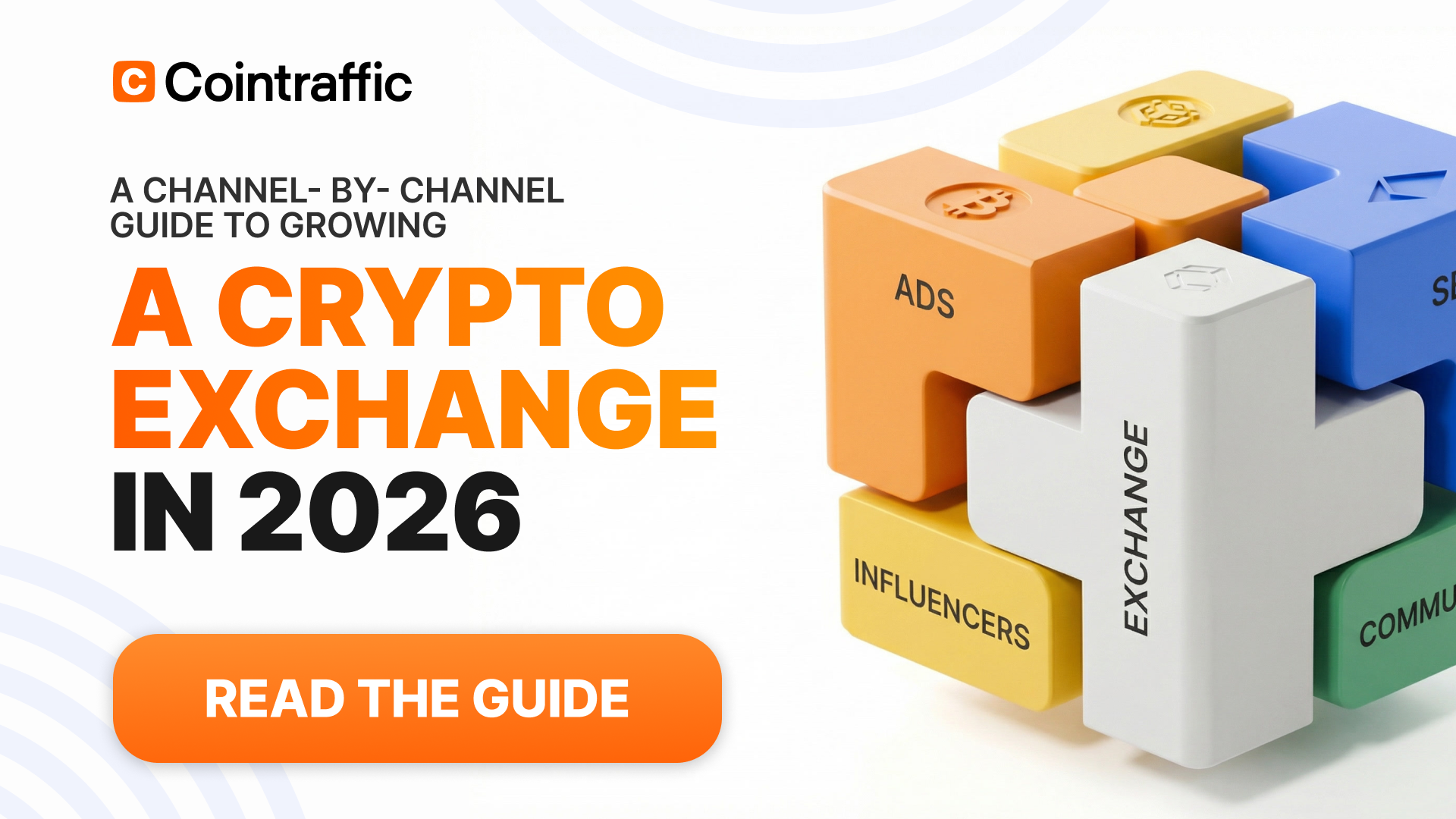
No single channel builds an exchange. The ones that grow combine several approaches, with each channel doing a specific job at a specific stage. For an exchange at an early stage, the sequence matters as much as the channel selection.
- Start with crypto-native advertising. It generates qualified traffic immediately. SEO and community both take months. Campaigns on platforms like Cointraffic start at €3,000 and reach audiences that are already in the market.
- Build content and SEO in parallel with paid acquisition, not after it. The organic channel takes 3 to 6 months to gain traction. Starting early means it compounds while paid campaigns run and keeps working after they stop.
- Open community channels before launch. An active Telegram or Discord at launch signals that the exchange has people behind it. Build the audience before there is a product to show.
- Launch the affiliate program once the product is stable. Affiliates who send traffic to a broken onboarding experience do not come back. Their audiences are finite.
- Use influencer placements for specific moments. New listings, market entries, product launches. Tie every placement to a referral code and measure by funded accounts, not views.
Start With the Right Audience
The channels in this guide work at different speeds and different stages. Paid advertising starts producing results immediately. SEO compounds over months. Community builds something that fees and bonuses cannot replicate. None of them work in isolation.
Cointraffic has been the advertising infrastructure for exchanges, wallets, and blockchain projects since 2014. With 700+ publishers, four ad formats, and campaigns starting from €3,000, it is the most direct path from budget to traders who are actively looking for a platform.
Start your campaign at cointraffic.com.